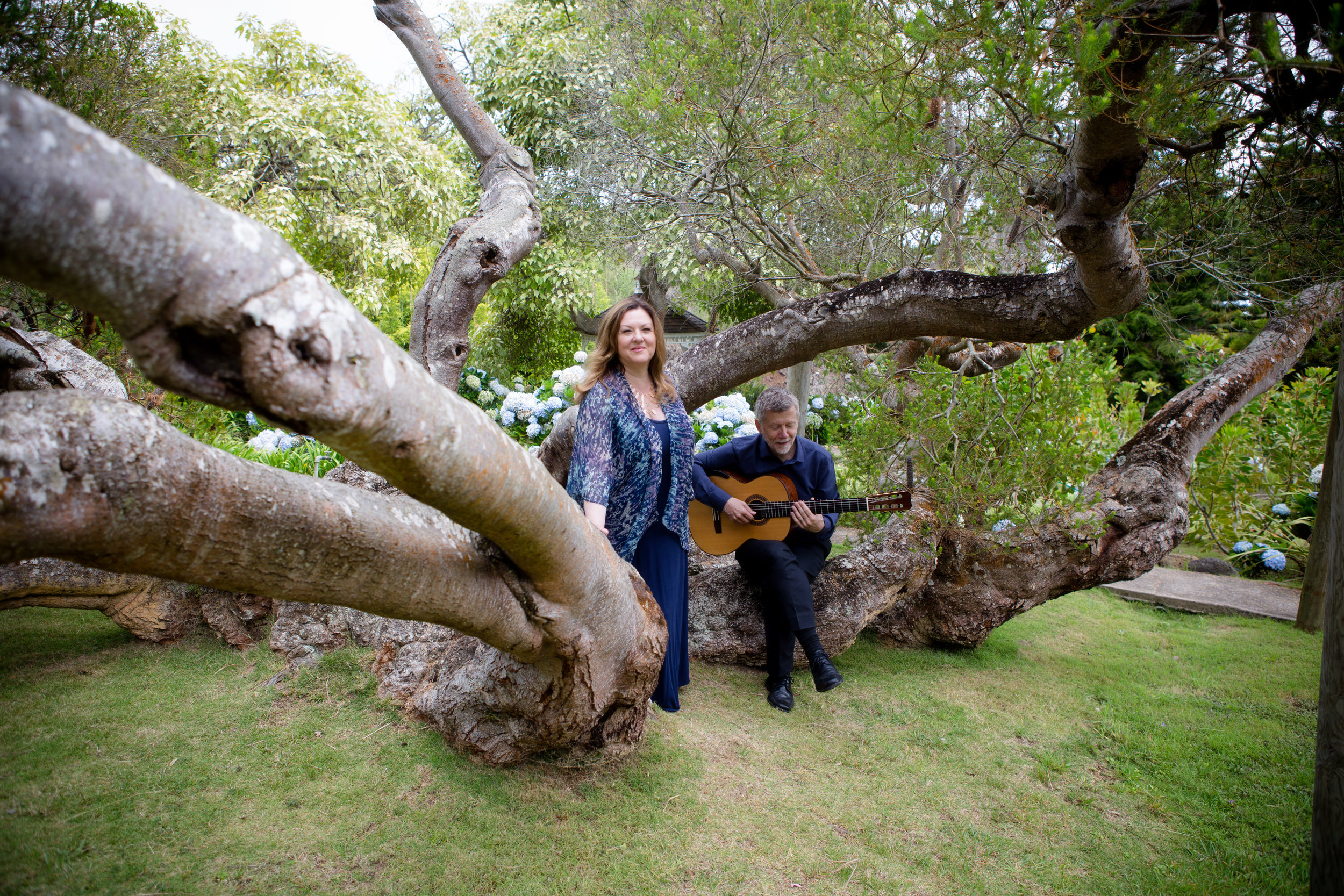
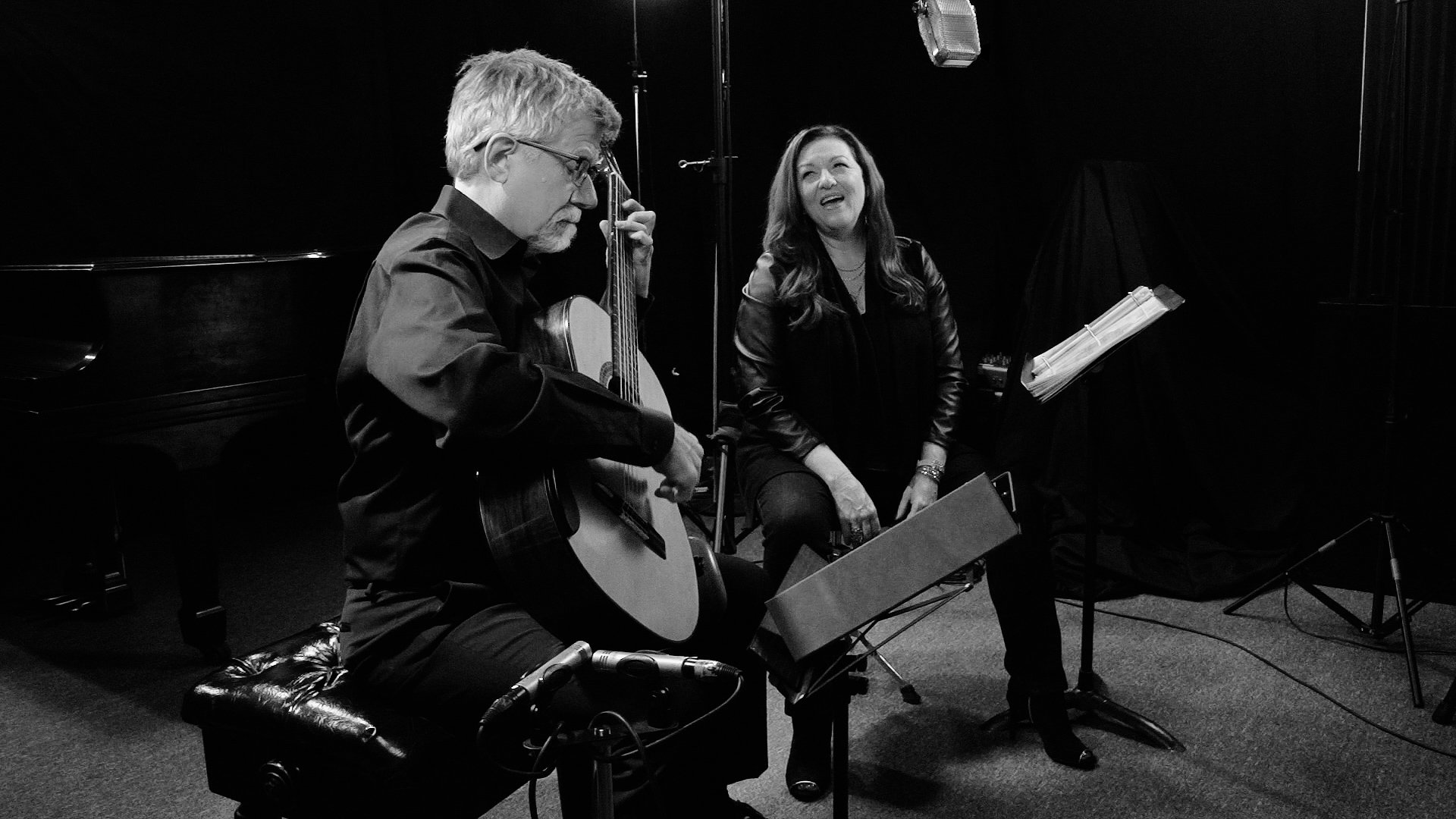
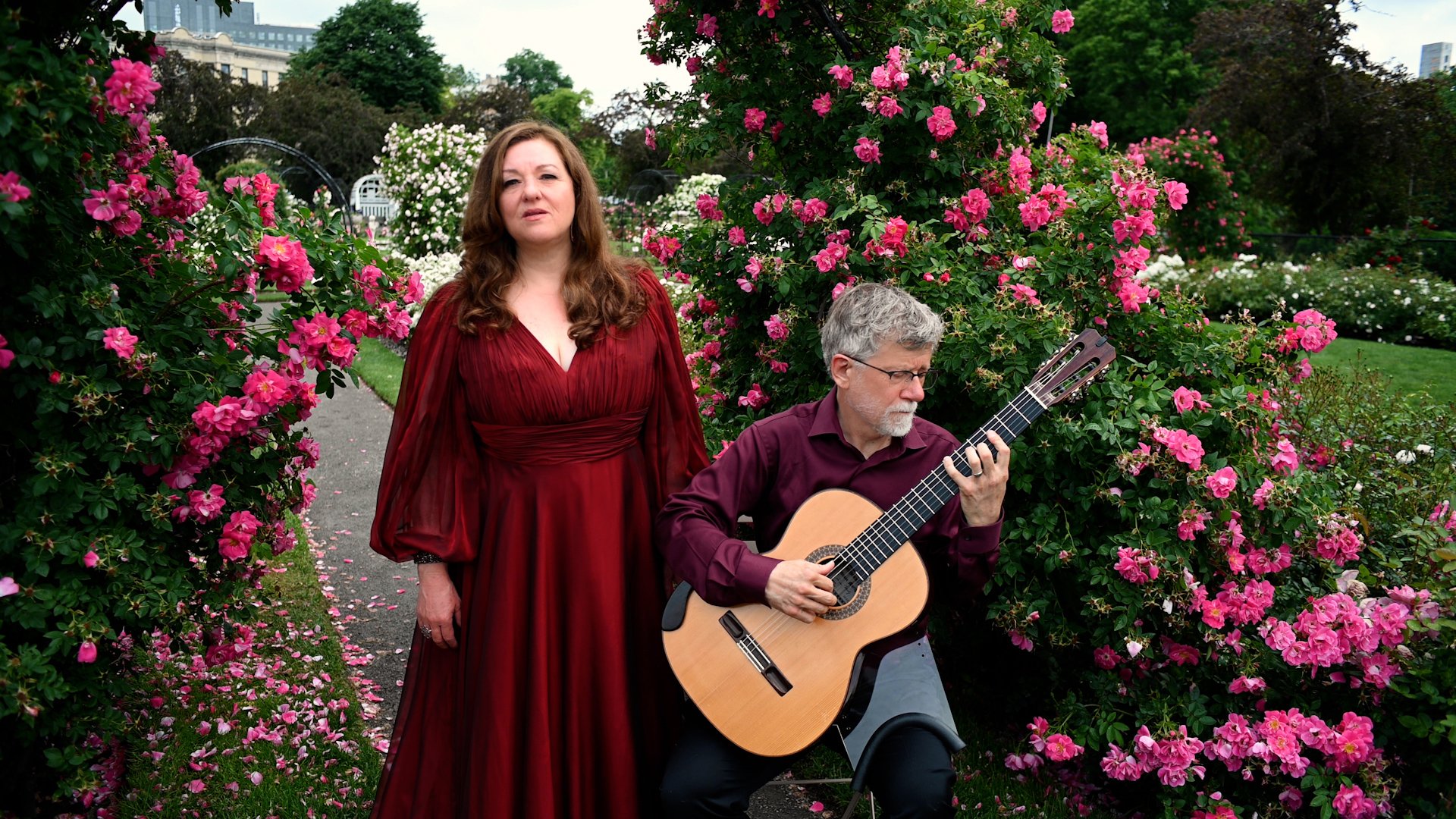
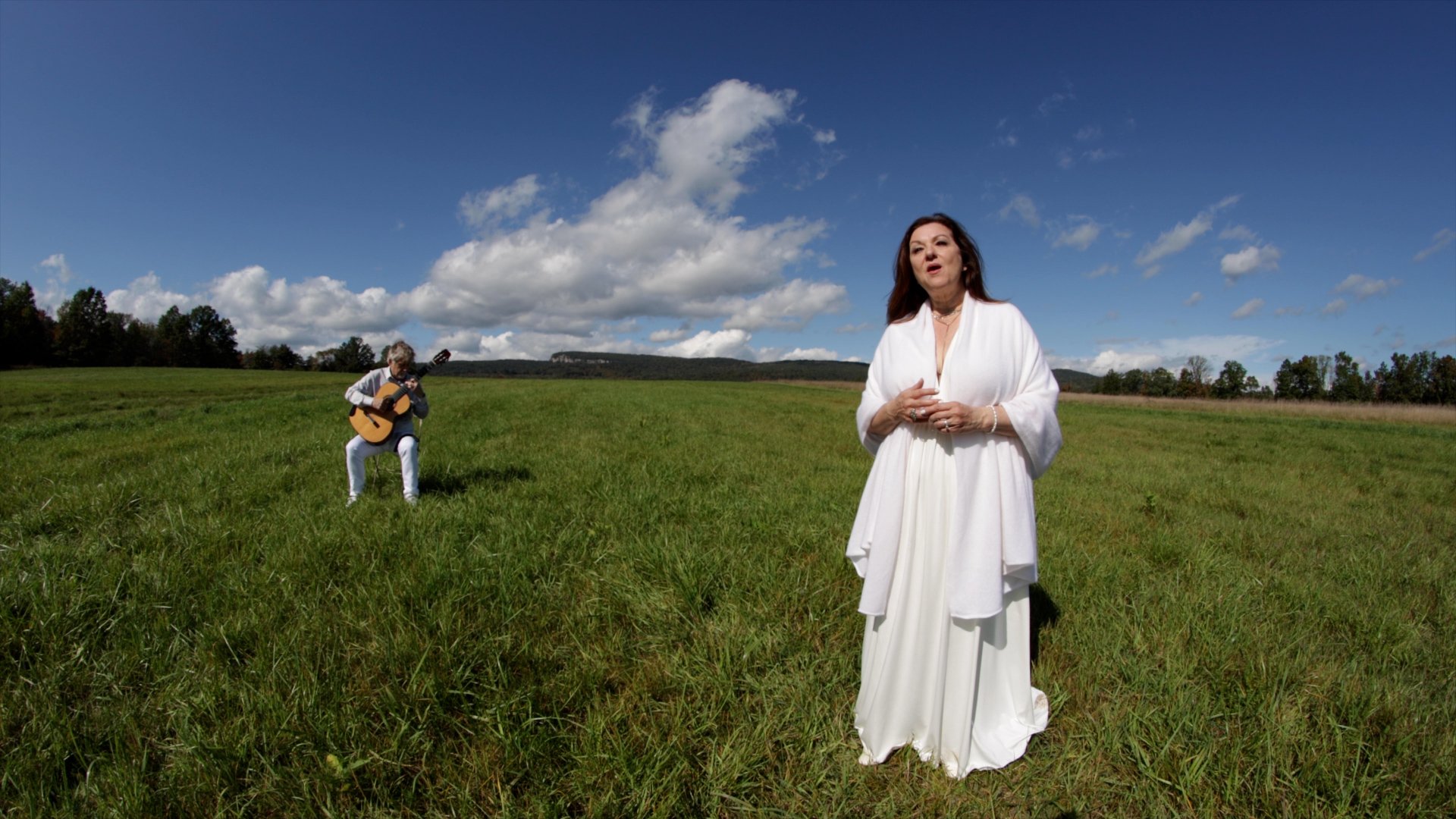
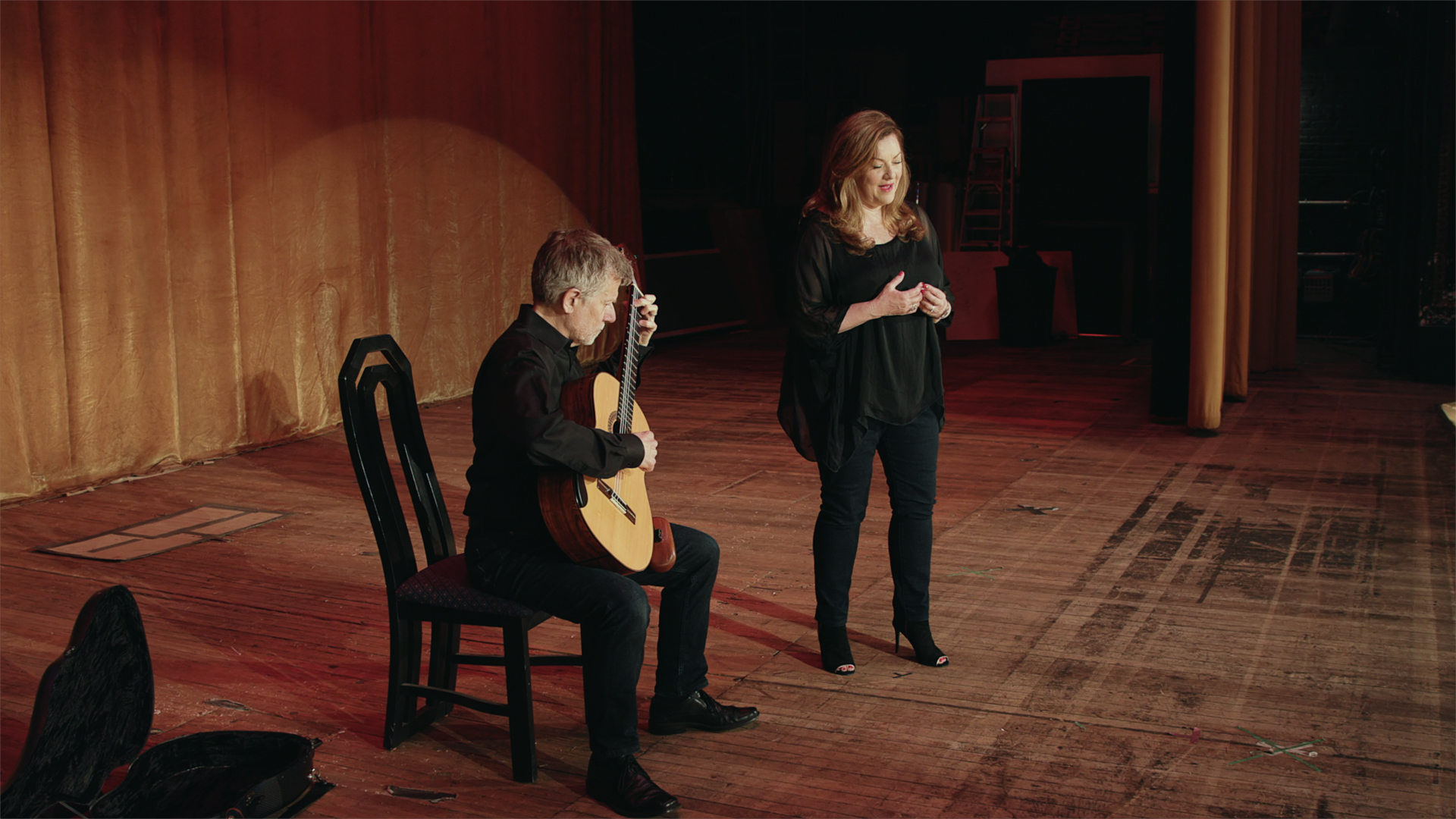
Welcome to the web site of the Olson/De Cari Duo. We draw on our music, science, and theater backgrounds to expand the guitar/voice repertoire in innovative directions.
We are commissioning music based on science themes — read about our Science/Music Commissioning Project. For more information about us, please see our bio page.
The latest news is below; or check out John's Science and Music Blog.
Feb 14 2010
We are very excited to have just received the music from our latest commission. Frank Wallace has written for us a six-movement song cycle entitled Men, Women and Molecules, based on the beautiful poetry of Nobel Prize-winning chemist and accomplished poet and playwright Roald Hoffmann of Cornell University. Frank wrote this about the set:
The six-song-cycle begins with musical references to Roald’s Eastern European roots, minor scales with augmented seconds and compound meters. It progresses into lighter jazz harmonies, symbolic of his new homeland, in “Where shall I look for her?” and uses the image and music of “Amazing Grace” as sung by Judy Collins. The major seventh interval plays an important role throughout the cycle, both as a clashing dissonance, and as part of sentimental jazz chords. “Next slide, please” is a light-hearted jab at the academic world of science, but it proved the most daunting to set. The clashing dissonances and awkward melodies are intended as a technical or scientifically calculated counterpoint to, rather than a direct expression of, the inherent humor in the poem.
Learning these pieces will be a lot of fun, and we look forward to premiering them in the coming months.
Jan 2 2010
New Commission: Chemistry and Music
Filed Under News, Science/Music Commissioning Project | Leave a Comment
We are very excited about the latest piece in our Science/Music Commissioning Project. We have commissioned composer Frank Wallace to write a song cycle for us based on the poetry of Roald Hoffmann. Dr. Hoffmann is a Nobel-prize winning chemist and Professor at Cornell University, and also a wonderful poet. His poetry is beautiful and insightful, and often combines science themes with perspectives on human relationships. He runs a very interesting monthly series called “Entertaining Science” at the Cornelia Street Cafe in New York City, which pairs science presentations with eclectic musical performances.
Frank Wallace is a prolific composer of vocal music, guitar music, and music for other instruments. He is himself a fine guitarist and singer, and performs with his wife, Nancy Knowles, as Duo LiveOak. Frank directs Festival 21 in Boston, which is dedicated to new music for the guitar, and co-curates, with me, the Second Sundays Classical Guitar Concert Series in New York City.
It is an honor to be able to work with both Roald and Frank on this new piece.
Aug 8 2009
Gioia’s Solo Show
Filed Under News | Leave a Comment
Gioia’s solo show Truth Values: One Girl’s Romp Through M.I.T.’s Male Math Maze opens this Friday, August 14 at the New York International Fringe Festival, and then heads to Cambridge, MA, for its regional premiere at the Central Square Theater.
The show is the “true-life tale of a gifted young Berkeley chick taking on sexism while pursuing a math Ph.D. at M.I.T., where girls aren’t supposed to be girls … especially girls with a penchant for fighting back with fashion!”
For more information about the show, visit the Unexpected Theatre web site. For performance times and ticket information, click here.
Jul 31 2009
The Beauty and Brevity of the Hawaiian Islands
Filed Under News, Science and Music Blog | Leave a Comment
We’ve spent some wonderful time in Hawaii again this year, visiting friends on Oahu, enjoying the breathtaking landscape of Kauai, and attending Ben Verdery’s annual masterclass on Maui. We had the pleasure of performing in three concerts, and premiered the new piece Thomas Donahue wrote for us, Scientiphilicity. It has been wonderful once again to have had the opportunity to study and perform in this beautiful setting. I’ve posted some photos of the islands to our gallery page.
I’ve been struck this year once again by the physical beauty of the islands, but also, as I’ve read about their geologic history, by just how rare and special this place is. The islands arose from the movement of tectonic plates, resulting in the creation of huge volcanic mountains, some of which rise over 30,000 feet from the ocean floor. The combination of the extreme geographic isolation of the islands — over 2,400 miles from the nearest land mass — and the persistent trade winds has created the remarkable climate that shaped — and continues to shape — the landscape. The winds bring moist ocean air from the east; as the air encounters the volcanic mountains and travels upward, it cools and brings rain. This process occurs continually, so that regions at high elevations receive abundant rainfall. Mt. Wai’ale’ale on Kauai, for example, is one of the rainiest spots on earth, with over 400 inches of rain annually. As the air continues to the west side of each island, it is depleted of moisture, resulting in dry conditions on the leeward side.
The rain results in significant erosion, which is one of the forces that has created the magnificant terrain on Kauai and the other islands. Eventually, erosion and other physical, chemical and biological forces will take their toll, and each island to sink below the surface of the ocean. The oldest of the main islands, Kauai, is only 5 million years old, but in another 2 – 3 million years it will be reduced to a much smaller island, similar to the small, uninhabited islands that extend to the northwest along the Hawaiian Archipelago.
The youngest of the islands, the Big Island of Hawaii, is less than half a million years old, and is still forming from active lava flow. Maui is only 1.3 million years old, but it, too, in a few million years, will be gone. To put that in some perspective, consider that the earliest humans — not Homo sapiens, but closely related hominids — already existed when Maui was forming. Or imagine the history of the earth compressed into one day: Maui would have existed for only the last 30 seconds of that day, and in another few minutes, would be gone.
But as older islands die, new ones are born, each unique, each beautiful in its own particular way. We as humans are fortunate to exist in this period of geologic history when we can enjoy this truly incredible place.
Notes
The geologic information above is from Kauai’s Geologic History by Chuck Blay and Robert Siemers, published in 2004 by TEOK Investigations.
Email this post
May 3 2009
Scientiphilicity
Filed Under News, Science/Music Commissioning Project | Leave a Comment
We’ve received the second in our series of new pieces for voice and guitar based on science themes. This one, entitled Scientiphilicty, was written for us by composer Thomas Donahue. The texts are based on the writings of a number of renowned scientists, including Albert Einstein, Marie Curie, Niels Bohr, and Jacob Bronowski. The texts provide insight into what doing science entails, and draw interesting parallels between art and science.
Apr 12 2009
Creativity in Science and Music: Thoughts from Edvin Østergaard
Filed Under Science and Music Blog | Leave a Comment
Left: Albert Einstein in 1905.
On a recent trip to Boston, we had the pleasure of meeting Edvin Østergaard, Ph.D., a Norwegian composer and scientist. He is currently a visiting scholar at Harvard University, where he is working on a choral piece based on a text by Charles Darwin. Edvin has composed several pieces that use science as inspiration, and has also written on the connections between science and art. He published a paper in 2006 entitled “Composing Einstein: exploring the kinship of art and science,” in which he discusses his composition The Einstein Resoundings, commissioned by the Norwegian Society of Physics in 2005 for the centenary celebration of the publication of Einstein’s papers on special relativity and the particle nature of light.
In the paper, Edvin discusses complementarities of art and science, as well as differences. One particularly interesting section is his consideration of creativity:
This leads us to a final question concerning differences between art and science: Do scientists discover, while artists create? There are deep-rooted and equally problematic prejudices in both directions: The scientist is supposed to discover, that is to say reveal, unwrap something already existing, whereas the artist’s creation is unique. A common view of the artist is of someone who creates what did not exist beforehand. However, as Gunther Stent argues, we find uniqueness in both artistic and scientific work. It is evident that the exact synthesis of the elements of physics in the 1905 papers would not have existed without Einstein, no more than Fünf Klavierstücke would have existed without Schoenberg. On the other hand, a theory of relativity would most likely have been developed even if Einstein had failed to do so in 1905, and dodecaphony would most probably have been formulated even if Schoenberg had not got there first. Michelangelo talked of his sculpture in terms of removing superfluous marble covering the immanent form of the stone. The form of the statue is already there, he claimed, waiting to be dis-covered. Is it thus more relevant to define art as well as science as both commonplace and unique?
Both scientific and artistic creativity operate within certain bounds. Scientific insights must be tested by others and verified experimentally. Artisitc creations, while not subject to empirical verification, do have to pass a test of sorts. In a piece of music, for example, the composer must express something that others will respond to — the music must, in however abstract a way, communicate something true, something human.
Edvin concludes:
Creation is an ongoing process that has always existed and will continue to go on. Art and science are inextricably connected to the will to bring to expression. Although artistic and scientific expression themselves may be totally different — in terms of form, language, and aesthetic — there nevertheless seems to be a common striving to bring to the surface. And although what is brought into the world may seem new, fresh and innovative, the process itself is of archetypal dimensions. In this sense the world is not finished — it is open.
Maybe the most characteristic common hallmark of art and science is the resounding imperative of opening — by always questioning accepted truths.
Notes
Edvin’s paper is Østergaard, E. (2006) Composing Einstein: exploring the kinship of art and science. Interdisciplinary Science Reviews 31:261–274.
The reference to Gunther Stent in the quoted section above is to Stent, G.S.(1983) Creation in art and science. Interdisciplinary Science Reviews 8:371–378.